Red Flags When Hiring Senior IT Contractors
More and more, organizations are relying on senior IT contractors to lead transformation programs and step into interim C-suite roles.
At this level, hiring mistakes can easily compound over time. Most senior contractors are capable and skilled, but they need to be in the right place at the right time. Getting the call wrong can have major implications.
In fact, Gartner research shows that only 48% of digital initiatives meet or exceed their intended business outcomes, while 86% of CIOs report increased competition for qualified IT talent.
So, the right talent is hard to find and, without it, your goals are out of reach.
At Alpha Apex Group (AAG), we work closely with organizations hiring senior technology leaders, including CIOs and fractional executives, and we’ve seen consistent patterns behind both successful and failed engagements.
In this article, we break down the senior-level red flags that matter most and lead to decision risks that only become visible months later.
Why Senior IT Contractor Red Flags Are Different
At senior levels, risk compounds. Here’s how it works:
Senior IT contractors typically operate with broad autonomy, executive trust, and authority to set direction. They don’t simply execute tasks.
They influence not just what gets built, but how the organization thinks about architecture, security, and governance.
Those decisions compound over time, which shapes operating costs and the organization’s ability to adapt long after the contract ends.
A good senior IT contractor makes decisions that hold up when real operating pressure sets in.
However, the red flags are hard to spot before you hire them or even in the first few weeks.
Early outcomes can look positive. Systems go live, milestones are met, and stakeholders feel reassured. The consequences tend to surface later, when:
Systems need to scale.
Audits occur.
Regulatory scrutiny increases.
Or internal teams are asked to operate and evolve what was built.
By then, decisions are deeply embedded and expensive to reverse.
This dynamic is well documented. McKinsey’s research shows that around 70% of corporate transformations fail to deliver full value, often due to gaps in leadership, skills, and execution rather than because the technology itself was flawed.
As Larry Quinlan, Global CIO at Deloitte, puts it:
“The role of a technology leader is not to develop a digital strategy or vision — it is to embed digital in the business strategy.” (Larry Quinlan, Global CIO at Deloitte, The new CIO: Business-savvy technologist)
This is why senior-level mistakes differ from junior ones.
Junior errors are visible and localized.
Senior errors are structural and systemic.
These risks emerge slowly, making them easy to miss during hiring, and that’s where most existing red-flag advice falls short. That brings us to the next point.
What Most Red-Flag Lists Get Wrong
Most red-flag lists focus on familiar, surface-level signals, like:
Communication style
Attitude and culture fit
Obvious professionalism issues
That advice can help with junior or mid-level roles, but it breaks down almost entirely at senior levels.
Senior IT contractors interview well by default. They know how to speak to executives, frame experience convincingly, and handle high-stakes conversations with polish. Their credentials are real and verifiable, and their resumes reflect genuine experience. As a result, the surface signals most red-flag lists rely on are already optimized for executive hiring.
The real failure modes are far less visible:
Incentive misalignment that favors short-term wins over long-term stability
Context blindness, where past success is applied without regard for the current environment
Poor framing of risk and trade-offs, with downsides minimized or ignored
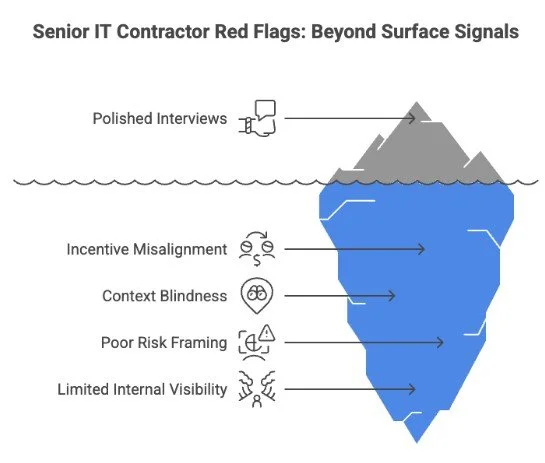
These issues rarely show up during interviews.
This creates false reassurance because leaders feel confident after polished interviews. Then, early milestones reinforce the illusion of success, and structural issues tend to fly under the radar.
The challenge is compounded by limited internal visibility.
Gartner research shows that only 8% of organizations have reliable skills data about their own workforce, and fewer than 20% can effectively redeploy internal talent to close skill gaps. Without a clear picture of internal capability, it becomes even harder to evaluate how a senior contractor will truly fit.
That’s why this article is not a behavioral checklist. It’s a framework for evaluating judgment quality, which is the same lens Alpha Apex Group applies when we assess senior technology leaders, like fractional CISOs and other executive-level specialists.
The Red Flags That Actually Matter When Hiring Senior IT Contractors
Hiring mistakes at the senior level are expensive. Industry data suggests a bad hire can cost between 1.5x and 3x the employee’s salary once lost productivity, disruption, and rework are factored in.
Here are 8 red flags to watch out for when hiring senior IT contractors.
Red Flag #1: They Treat Architecture as a Deliverable, Not a Living System
You see this red flag when senior contractors focus heavily on visible outputs, like:
Target-state diagrams
Roadmaps and reference architectures
Clean, polished handover artifacts
Make no mistake, these are useful, but the risk lies in what gets less attention in the meantime.
Often missing from the conversation are:
System operability once the contractor exits
Lifecycle cost, including maintenance and support overhead
Clear ownership after the engagement ends
This means architecture decisions end up being optimized for completion rather than actual long-term impact. The engagement finishes successfully, but teams later inherit systems they didn’t help shape and don’t fully understand. Decision rationale is thin or undocumented, which in turn makes future changes slower and riskier.
Over time, even small adjustments require outsized effort. Not because the design was fundamentally flawed, but because it wasn’t designed to be lived in.
Remember: Strong senior contractors design for continuity, not just delivery.
Red Flag #2: Their Success Is Highly Context-Specific, but Presented as Universal
Many senior IT contractors have impressive track records, but those successes usually come from very specific environments.
It’s a red flag when candidates:
Rely heavily on success in a single operating model
Assume past approaches transfer cleanly to new contexts
Underestimate how regulation, legacy systems, or resource constraints change outcomes
What worked in a well-funded, digitally mature organization may fail badly in a regulated, legacy-heavy, or capacity-constrained environment.
When senior contractors assume conditions that don’t exist, their decisions quietly create friction and fragility.
At AAG, we stress-tests this by:
Probing how candidates adapt approaches across different operating realities
Exploring failures, constraints, and compromises
Evaluating judgment under non-ideal conditions
Red Flag #3: They Optimize for Technology Change Instead of Business Stability
Modernization being framed primarily as a tool or platform replacement is another tip-off.
Common warning signs include:
Constantly introducing new technologies without clear downside analysis
Emphasis on velocity and novelty over long-term impact
Not much discussion of how tools might disrupt your organization
Change is treated as inherently positive, while the cost of instability is downplayed. The impact on teams, customers, and day-to-day operations is underestimated. Over time, the organization pays for this through outages, burnout, and loss of trust.
Red Flag #4: Governance, Security, and Compliance Are Treated as Afterthoughts
This red flag usually hides behind language about speed and delivery. It appears when:
Security and compliance are framed as blockers
Remediation is deferred (for example, saying, “we’ll harden later”)
Audit, regulatory, or security requirements are weakly integrated into the design
Things might look fine at first, but risk builds up in the background. The real consequences surface later, like during audits, incidents, or regulatory reviews, and in most cases after the contractor has left.
Red Flag #5: They Assume Engineering Capacity Is Elastic
If systems are designed for an idealized future team, that’s a red flag. Warning signs include architectures that assume:
Fast hiring timelines
Low attrition
Minimal operational workload
Delivery plans become disconnected from reality. Once the initial push ends, teams struggle to support what was built, and systems become fragile as momentum fades.
As CIO.com notes:
“Many IT leaders undervalue the importance of partnering closely with business peers and speaking the language of strategy and outcomes.”
This includes realistic capacity planning.
Red Flag #6: They Become the De Facto Decision and Architecture Hub
This warning sign may be misinterpreted as strong leadership at first. Over time, it shows up as:
Critical decisions all pass through one individual
Teams are always waiting for approval instead of acting
Key knowledge is concentrated in the contractor’s head
Limited documentation of decision rationale
This means progress slows and dependency on one person grows. When the contractor exits, teams face a massive challenge to maintain or evolve systems with limited understanding or experience.
That’s a bigger problem than you may imagine: Gartner reports that 45% of CIOs are actively sharing technology leadership with business peers, so 55% of them do not cooperate well.
Red Flag #7: Technical Risk Is Framed as Certainty Instead of Probability
Senior contractors should talk about risk in gradients as opposed to absolutes. Red flags include:
Overconfident claims about scalability, performance, or security
Little discussion of failure modes
Risk framed as binary (like saying, “this will work”)
No clear mitigation or contingency planning
Certainty might sound reassuring, but there’s a good chance it’s covering up some unexamined assumptions.
Red Flag #8: There Is No Clear Technology Exit or Transition Plan
The strongest senior contractors plan their own exit, and failing to do this can lead to chaos and uncertainty.
This red flag appears when there is:
No defined ownership transfer
Weak or absent knowledge handover
Ongoing dependency on the contractor after the engagement ends
Post-exit, teams can struggle to operate or evolve systems confidently. Your contractor should always be thinking about what will happen after they depart, and setting up processes to keep things working.
A Practical Executive Pre-Hire Reality Check for Senior IT Contractors
Senior IT contractors are hard to evaluate, especially for non-technical executives. The main goal of a pre-hire check is to assess judgment, risk awareness, and decision quality. The questions below are designed to help you get there.
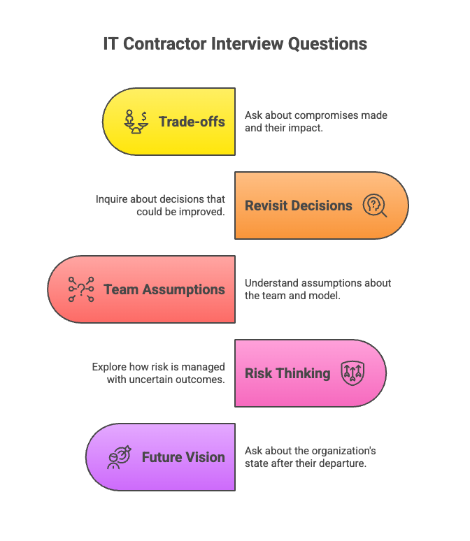
The Best Questions to Ask When Hiring a Senior IT Contractor
1. “What trade-offs did you make on your last engagement, and who felt them most?”
Strong answer: Names specific compromises and explains why they were acceptable.
Weak answer: Describes only wins, with no downside acknowledged.
2. “What decisions from that project would you revisit today?”
Strong answer: Shows reflection and learning under real constraints.
Weak answer: Claims everything worked as intended.
3. “What assumptions are you making about our team or operating model?”
Strong answer: Actively probes your context and capacity.
Weak answer: Assumes ideal conditions without making sure.
4. “How do you think about risk when outcomes are uncertain?”
Strong answer: Talks in probabilities, mitigation paths, and options.
Weak answer: Uses absolutes like “this will work” or “this won’t scale.”
5. “What should the organization look like after you’re no longer involved?”
Strong answer: Describes ownership transfer and reduced dependency.
Weak answer: Avoids the question or centers themselves.
How Alpha Apex Group De-Risks Senior IT Contractor Engagements
Rather than matching resumes to job descriptions, AAG starts with context. We work with clients to understand the business objectives behind the role, the organization’s operating maturity, and the level of risk the business can realistically tolerate. That context drives how senior contractors are evaluated and matched.
Candidates are assessed through scenario-based discussions. This allows us to evaluate how they reason through trade-offs, uncertainty, and real-world constraints, in other words, the conditions that define senior decision-making.
We look for fit across three core areas:
Business objectives, beyond delivery milestones
Risk tolerance, including where caution matters most
Operating maturity, based on what the organization can actually support
AAG’s involvement doesn’t stop at placement.
We provide ongoing support and course correction throughout the engagement to help prevent early decisions from creating long-term constraints.
Our goal isn’t dependency.
Alpha Apex Group operates as a long-term partner, helping organizations engage senior IT contractors who leave teams stronger, more capable, and better positioned for what comes next.
How AAG Helps You Turn Senior IT Talent into an Advantage
Senior IT contractors can be a powerful advantage, but only when they’re hired and supported with the right lens. At this level, seniority can actually concentrate risk. The same autonomy and authority that accelerate progress can just as easily lock organizations into fragile decisions that take years to unwind.
Alpha Apex Group exists to prevent exactly that outcome. We help organizations engage senior IT contractors with a clear understanding of context, risk, and long-term impact. Our approach goes beyond role matching to focus on decision quality, alignment, and durability, so your senior contractors strengthen the organization rather than creating hidden dependency.
If you want the benefits of senior IT leadership without the long-term liabilities, get in touch with us.
FAQ
What should be included in the scope of work for a senior IT contractor?
The scope of work should define decision authority, measurable outcomes, reporting structure, transition expectations, and risk ownership. Avoid vague mandates like “lead transformation.” Tie responsibilities to business objectives, governance standards, and operational durability so expectations are clear before execution begins.
How do we ensure legal compliance when hiring a senior IT contractor?
Clarify legal compliance early by reviewing liability insurance coverage, confidentiality clauses, intellectual property rights, and any non-compete clause obligations. A well-structured contract recipe reduces exposure to legal disputes, especially in regulated industries or cross-border engagements.
How should the interview process differ for senior IT contractors?
The interview process should test judgment, not presentation skills. Move beyond employment histories and ask scenario-based questions that probe trade-offs, risk framing, and executive communication. Evaluate both hard skills and soft skills to assess whether the contractor can influence stakeholders under pressure.
What are core competencies at the executive level?
At senior levels, core competencies extend beyond technical depth. They include strategic framing, governance design, stakeholder alignment, and risk modeling. Unlike mid-level hiring, the focus is less on execution and more on decision architecture that shapes the IT team long after the contract ends.
How do we protect intellectual property and confidential data?
Senior contractors often access sensitive systems and client relationships. Strong confidentiality clauses, clear intellectual property rights assignment, and defined access controls are essential. The contract should also outline data handling expectations, especially in remote work environments where oversight differs from on-site engagements.
How do we structure total compensation for senior IT contractors?
Total compensation should reflect scope, risk exposure, and transformation impact. Beyond base rates, consider milestone incentives tied to measurable outcomes. Overpaying doesn’t reduce risk; alignment does. Compensation must match responsibility without incentivizing short-term wins over durable system stability.
What risks arise if we skip a structured HR playbook?
Without an HR playbook tailored to senior contractors, expectations drift. Misalignment can affect safety protocols, governance clarity, and cross-functional execution. Executive-level hiring requires documented evaluation criteria, onboarding guardrails, and exit planning to avoid overdependence on one individual.
How do we evaluate cultural and operational fit for remote senior contractors?
Remote work increases autonomy, which compounds risk. Evaluate how candidates integrate with your IT team, communicate across time zones, and adapt to your operating maturity. Strong technical ability is insufficient if the contractor cannot align with business stakeholders and internal decision rhythms.